Product Design / Service Design / Event Operations / Field UX
Podemos Progresar — Productive Workshops
A connected event operations ecosystem across LUCI, Spore, and web, unifying workshop creation, registration, field execution, attendance tracking, and prospecting.
Client
Podemos Progresar
Industry
Financial services
Location
Mexico City, Mexico
Year
2024
Time frame
4 months
Role
Lead Product Designer
Platforms
LUCI / Spore / Responsive Web
Scope
Event Creation / Registration / Field Operations / Prospecting / Analytics
Tools
Figma / Notion / Jira / Asana
Deliverables
Product Strategy
UX Research
Service & User Flows
Information Architecture
Role-based UX
Event Management
Dynamic Forms
Responsive UX/UI
Field UX
Prototyping
Usability Validation
Analytics Definition
Developer Handoff
Project overview
Productive Workshops were part of an operation far more complex than simply publishing events.
Each workshop involved different teams, regions, coordinators, objectives such as prospecting, retention, or social impact, attendance targets, locations, forms, primary attendees, guests, pre-event follow-up, on-site operations, and post-event reporting.
The challenge was to transform this fragmented process into a connected digital system.
As Lead Product Designer, I led the definition of an experience that allowed an event to be configured once and then used across different operational contexts: LUCI for administration and control, the public website for discovery and registration, and Spore for coordinators working in the field.
The outcome was a shared architecture built around the complete event lifecycle rather than isolated tools for each platform.
Designing the Event as a System
From a workshop activity to an operational product
The first challenge was understanding that a workshop was not simply a date on a calendar.
Behind each event was a network of relationships between regions, tribes, coordinators, attendees, guests, objectives, locations, forms, statuses, and attendance goals.
Research and definition work helped map the complete journey and establish an architecture in which different platforms could consume the same information according to each role and context.
This transformed the event into a central entity within the ecosystem, connecting what happened before, during, and after each workshop.
Event Creation & Orchestration in LUCI
One workflow to configure the entire operation
LUCI was designed as the control center from which internal teams could configure and manage Productive Workshops.
The experience followed a progressive workflow divided into three main stages:
Event Details → Create Form → Preview & Publish
From one flow, teams could define the region and tribe, workshop type, objective, format, attendance target, date, schedule, location, responsible teams, coordinators assigned to prospecting, and public-facing event information.
Each event also incorporated a unique identifier derived from its operational context, creating a consistent reference across the different touchpoints of the ecosystem.
Flexible Registration Without Rebuilding Every Event
Configurable forms for different operational needs
Not every workshop required the same information.
The experience therefore included a configurable form system in LUCI, allowing teams to create sections, questions, answer types, mandatory fields, and event-specific information structures.
A dedicated ID upload module was also designed to support OCR-assisted data capture, extracting information such as name, age, address, postal code, and CURP from an uploaded ID.
The system also supported guests linked to a primary attendee.
When an attendee indicated that she would bring guests, the system could generate the necessary subforms and preserve the relationship between every participant and the event.
This reduced the need to create a completely new workflow every time workshop requirements changed.
From Internal Operations to Public Discovery
Turning internal event data into a public experience
Once published, a workshop stopped being only an internal operational record.
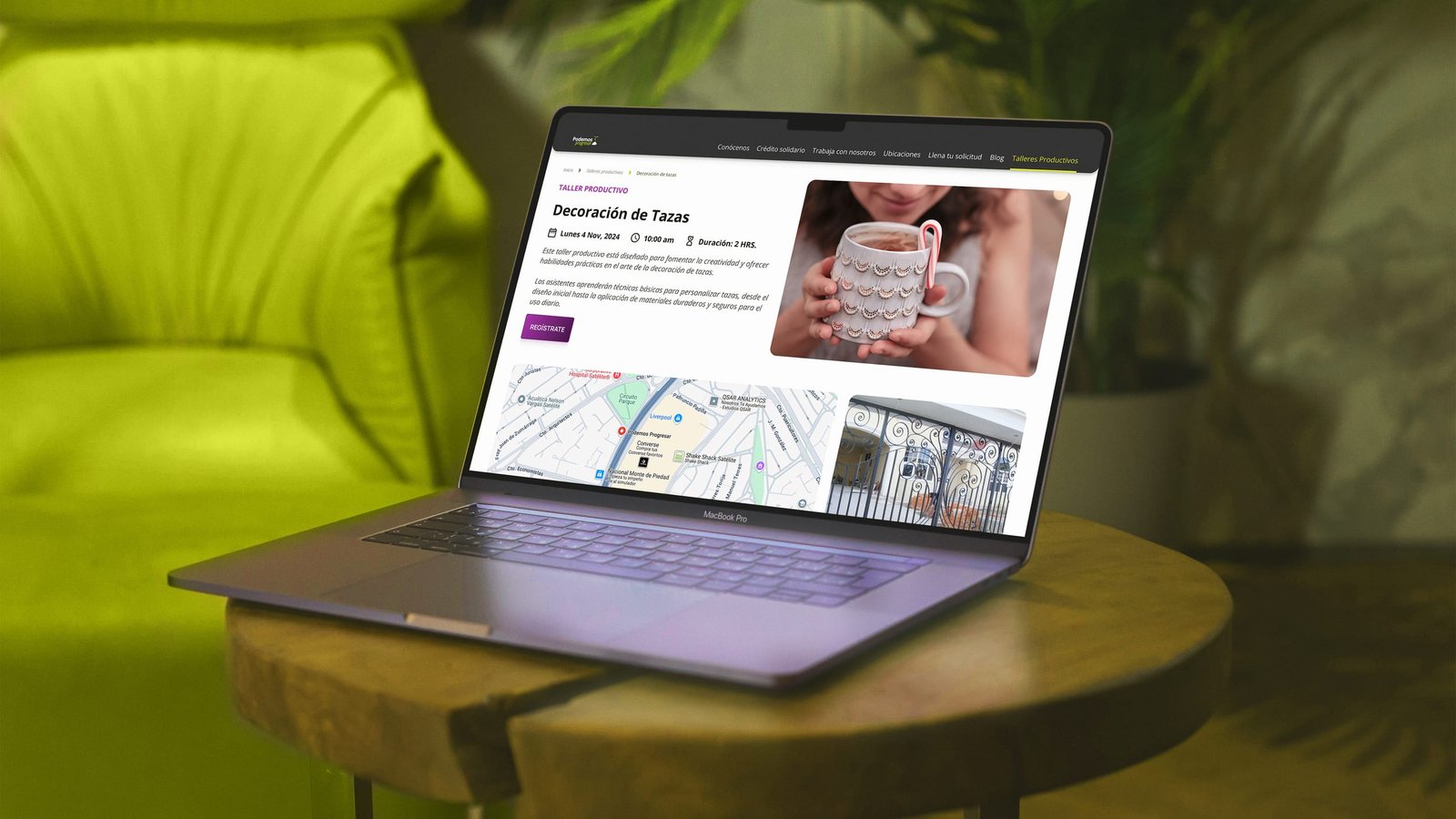
The same event could appear inside the public experience through listings, categories, filters, map views, and detail pages containing date, schedule, location, workshop information, and registration.
This connected internal operations with a much more accessible discovery experience for potential attendees.
The event information did not need to be manually reconstructed for every touchpoint. The same definition could support different interfaces depending on the context.
Field Operations Through Spore
Designing for coordinators working outside the office
Spore extended the event model into the field experience used by the Coordinadores de Emprendedoras.
Coordinators could review scheduled workshops, navigate between dates, differentiate between prospecting, retention, and social impact events, and quickly understand progress against attendance targets.
Inside each workshop, the experience provided access to event information, responsible teams, locations, registered participants, guest information, and attendance-related statuses.
The flow also incorporated direct attendee registration for situations in which participant capture occurred during field operations.
The result was a mobile-first experience designed around operational context rather than a reduced version of the desktop platform.
Turning Events Into Prospecting Channels
Connecting community activity with future relationships
One of the most important aspects of the system was that workshops could also act as an entry point for future relationships with Podemos Progresar.
Spore allowed coordinators to manage participants and guests around each event, capture relevant information during registration, and maintain statuses such as confirmed, reminder, attended, or no-show.
Rather than separating community events from prospecting activities, the experience connected both contexts within a controlled operational flow.
The workshop therefore became a surface where coordinators could register, organize, and follow up with new participants without disrupting the event itself.
QR, Direct Registration & Assisted Capture
Multiple entry points into the same workflow
Registration had to work both before and during the workshop.
For that reason, several entry points were considered: registration through the digital experience, event-specific QR codes, and assisted registration directly through Spore.
The QR code directed participants to the registration form associated with the event, while coordinators could register attendees directly when the process happened on-site.
Regardless of the entry point, participant information remained connected to the same workshop and operational structure.
Operational Visibility & Attendance
From individual registrations to operational visibility
The workflow extended beyond event configuration and participant registration.
LUCI was designed with views for monitoring workshops by region, attendance targets, confirmed registrations, attendance, no-shows, individual participants, guests, event history, and downloadable operational reports.
The information architecture allowed teams to move from a high-level view across regions and events into the detail of an individual workshop or participant while maintaining the original event context.
This created a more structured model for managing events, teams, goals, participants, and attendance within the same operational ecosystem.
Product & Operational Impact
Product & Operational Impact
The solution transformed a process distributed across teams, channels, and operational contexts into a connected system built around one central entity: the event.
LUCI centralized configuration and management. The public website transformed that information into a discovery and registration experience. Spore brought the event into the field, where coordinators could operate, register participants, track attendance, and manage prospecting activities.
The result was an architecture capable of supporting multiple workshops, forms, regions, teams, participants, and objectives without designing an independent process for every new operational need.
More importantly, the project demonstrated how a community experience could be structurally connected with the wider operational and prospecting ecosystem of Podemos Progresar.
Design note
My involvement covered product strategy, research, service and user flows, information architecture, UX/UI, interaction design, integration with existing design systems, prototyping, validation, and alignment with development and operations teams.
As Lead Product Designer, I led the end-to-end Productive Workshops experience across LUCI, Spore, and the public website, defining how each touchpoint could operate as part of the same system rather than as an isolated interface.
Reflection
Designing Beyond Screens
This project reinforced an idea that has strongly influenced the way I approach product design: operational problems rarely belong to a single interface.
A workshop started long before an attendee arrived at the event and continued after the event ended. Designing the experience required understanding the entire chain: planning, teams, publishing, registration, field operations, attendance, information, and follow-up.
The most important decision was not how to design an individual screen.
It was defining which information needed to remain consistent, what each role needed at every stage, and how different products could collaborate around the same operational model.
That shift made it possible to move from designing isolated interfaces to designing a connected system.